Pages

Wednesday, April 15, 2015

Full-swing Into Dry Fly Season : Skwalas On The Move


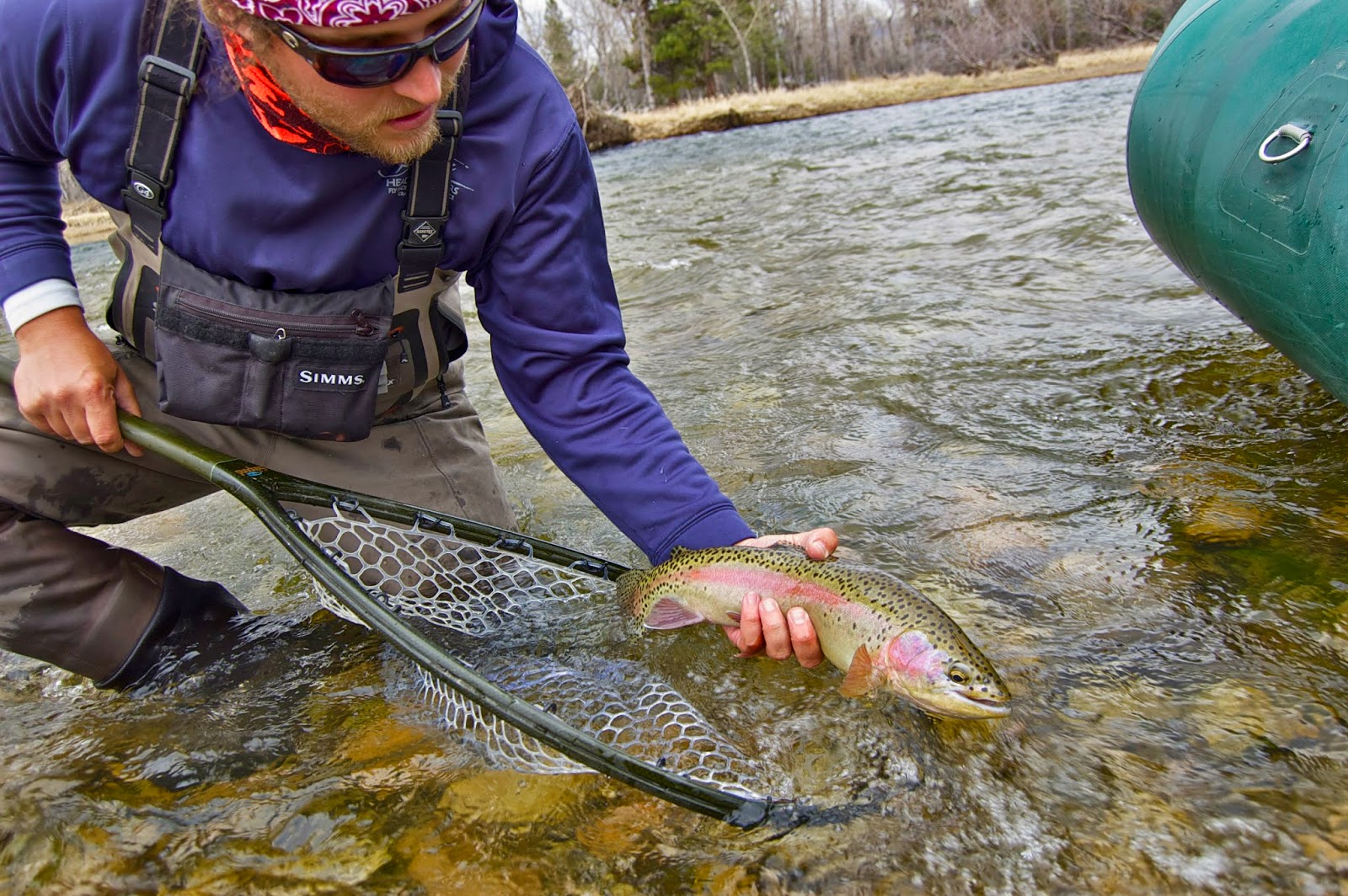
 Spring dry fly season is off and running here in western Montana, and a mild March and April have bought about one of the best Skwala stonefly hatches of recent memory. Stormy mornings and warmer afternoons have created perfect conditions for these stoneflies to hatch on the rocks and trees along western Montana rivers. As the first major stonefly hatch of the year, the Skwalas get the trout moving like few other hatches. From riffles to tail-outs, well placed drifts are being eaten with conviction as the trout begin to realize that easy meals are readily available after the long winter.

When it comes to spring pre-runoff fishing on the freestone rivers of western Montana, early isn't always better. Ideal dry fly conditions begin shortly before noon as the water warms and the trout start to focus on the first of the morning's bugs. The shoulder seasons of Spring and Fall are when trout apply the bankers hours for eating the dry. They feed hard from about 12-5, and most days that is all they will give you. Put yourself on the best water and move slow during this time to keep yourself into fish.


Trout this time of year are not everywhere. Hard banks, which feature fast churning water, rarely produce strikes on top during the early season; this is especially true with this years higher than normal spring flows. Trout want to eat as much as possible while expending the minimum amount of energy. They move into inside bends, eddies, and tail-outs, where food is plentiful and the water is slow, to feed during the colder water months of spring. By focusing on the slower lazy water you will keep yourself into fish until you are ready to hit home or the nearest brewery.


What makes a good Skwala pattern?
Small and sparse is key. Dry flies this time of year need to be as sparse as possible while still floating through the choppy water. Foam is not a necessity right now, as good stiff elk hair and quality CDC can get you though the rough water while keeping a natural look to your bug. The Skwala patterns that I tend to fish most are in sizes #10 and 12, but I will go to a full #8 if conditions are right. I usually lean towards fishing a bug that is one size smaller than the naturals that are on the water. This is especially important on those colder days or early mornings when the water temps have the fish thinking twice about rising. Often the smaller sneaky bug will draw a fish that would be unwilling to eat a larger fly.


Let the weather man fall on deaf ears:
The threat of bad weather can often keep many anglers at home and off the river. Those who are willing to endure the bad days are often rewarded with moments of dry fly glory all to themselves. A quick warm up after a morning of rain/snow can bring about some of the best dry fly fishing you see all year. Gor-Tex shells, quality waders, wool gloves, and a positive attitude, can keep you into fish even in the worst of conditions. Layer up and get after it. After all, what's a little snow.


Monday, April 6, 2015

Anglers Tonic on Pacific Salmon Populations


Here is a cool article from Greg Thomas over at Anglers Tonic regarding the growing controversy in Salmon management in the Pacific. Always a great ear to the ground regarding environmental impacts of industry and development Thomas' devotes special attention to Salmon and Steelhead news in the northwest. This article focuses on a study regarding increasing competition between populations of hatchery raised fish and native Salmon species. While long considered to be a unlimited resource for fish production it now seems that not all species thrive when total fish numbers increase. The article can be found here:


Anglers Tonic Pacific Salmon stocks


Sunday, March 29, 2015

Clark Fork Early, Clark Fork Often


Fly fishermen have their unique habits, the behavior patterns that make us similar to all other beats of the wild. Year after year it seems I find myself in the same strange rut as years gone by: Driving by the trusty ol' Clark Fork on my way some other far distant trout mecca, leaving the local river all by its lonesome. Why is this? After all the Clark Fork produces dense hatches of caddis and mayflies, supports herds of formidable wily Browns, and despite its proximity to Missoula gets a fraction of the fishing pressure of other area rivers (you Rock Creek / Blackfoot fishermen will know what I'm talking about here). This year I vowed would be a different story and I would make a half-hitched effort to explore the 80 or so miles of meandering trout haunts that lie between Missoula and Warm Springs.

Wading a river is always the best way to get a true understanding of it. You get a good long look at all the structure, rather than just blazing by in a raft, and if you still are not sure whats really down there you just go wade across it. The sheer popularity of float fishing is understandable but its easy to overlook how thorough the wade fisherman is by comparison: Changing tactics and patterns within the same run or eddy can be the difference between striking out and hitting paydirt. Thats not to say that the floating isn't a great way to get after a river too. After a couple a wade trips to learn the types of holding structure the raft gets set lose and the full-day run- n -gun trip is on. Ten miles at a shot of meandering undercut banks and choppy mid river riffle seams. Not a bad plan for a day out on the water, plus when you get a chance to look up from the river, the scenery isn't half bad.


Wednesday, March 18, 2015

Skwalas and Spring Meltdown


Spring is finally, fully underway these days and not a moment too soon: For those of us working through the dark winter months the cabinfever can get to be an ever-present chiming in the background, an itch for the outdoors and moving water that is a tough one to scratch. The spring equinox often signals the end of this dark stretch of the fishermans' calendar and the beginning of some of the best trout fishing of the year: Trout and angler alike seem emerge from hibernation with renewed passion for all things flyfishing. No better way to kick off the season on the Bitterroot then with a little dry fly action in the overcast!

With the warming temperatures comes the first major topwater action of the year with the hallowed Skwala stonefly. Though only a harbinger of the monster stonefly hatches of summer Skawals are a delicious early season morsel for the trout hungry from a long winter of slim pickings. Despite the throngs of eager rods patrolling the shoreline the it can be a notoriously hit-or-miss hatch for the angler. Quite a few of the rather helpless insects need to be on the water to get the trout's attention, but when they do the feed is fully on: A big Cutthroat can't help but slurp such a easy meal no matter where it happens to find it. Of course no Skwala fishing trip would be complete without that glorious spring weather. Tshirts and balmy sunshine one moment and spitting all kinds of sleety nasty snow pellets the next. Its always a good idea to plan on wearing the Gortex. All of it.


Best Spots Ever


Friday, February 20, 2015

Fly Tying: Woolly Bugger Alchemy


Our last post took a look at some foundational tricks in building flies, insights on technical aspects of tying that lead to less time spent behind the vise as well as better bugs. But what about refining patterns and building that collection of one-of-a-kind "secret flies", those flies that just drip with fishiness and get tied on it all the pressure situations? Over the years building as many bugs as I have (both commercial and personal) there are certain patterns that stick out as being perfect examples of this "dripping with fishiness", those bugs that seem to hop around on the bench and are begging to get thrown to a big gulper.


Go Natural:
Relying heavily on the long-time favorite staple materials is the best thing you can do for your fly box: Talking about Elk, Deer, Calf tail, Pheasant tail, CDC, and natural dubbing fibers. This emphasis helps enormously when it comes to building patterns that work all over the place, not just on your home waters; And work equally well on the selective and the uber-agressive fish. Mid-summer western MT on the Bitterroot, Blackfoot, Clark Fork, and Rock Creek, you can get away with throwing the most heinous birdnest of foam and spandex imaginable and it will get bit. Now compare that killer Bitterroot bug with a favorite from central MT like the Madison, Beaverhead, or Missouri. I guarantee you will see a fly built with CDC, elk, deer, calf, or just a pile of hackle. The synthetic materials are either supporting players at best or entirely non-existent. This might be read as a tacit argument for the superiority of Salmo trutta as an evasive fluvial predator (probably mos def) but that is a rant for another time. The flies that are considered sure bets on famous technical streams are mostly tied with natural fibers. The big fish and the spooky fish think they look better. Hmmmmm

This natural material bias also becomes the gold standard when tying the high-pressure patterns that get chucked at the biggest fish. My back-pocket top-secret big fish box contains no (NO!) foam flies whatsoever. To the untrained eye it is a detritus pile of ants/hoppers/cripples/tricos/emergers mixed with river mug and baked in the sun. If you tweeze out one of these flies, however, you will find a little bundle of hair and hackle that doesn't stand out or look out of place swirling around a scumline, or more likely hanging from a branch. "Damm that wind came up at the wrong time, didn't it!" These are the flies you learn to love and with time will come to rely on completely.


Gone (Rejected), But Not Forgotten:
Scrutinize the living S#%* out of every fly lying around your vehicle or fishing gear that has gotten the ever-loving piss chewed out of it: That one parachute that got crushed the first day of the hatch, 20+ fish on one bug that everytime it miraculously continued floating. . .  Slurp! That one bugger the fish would not leave alone in that one side channel below Craig. Why the hell were the fish all over that fly? Why weren't they smacking the other flies in the box? Checking the throw-aways is the fastest way to get at answering this question. Build the traits of these killer bugs into the rest of your arsenal and see what happens.  

Another good way to think about how flies could look is to look at those that get rejected from the bench: The ones that never see the fly box and get given away or straight chucked in the trash. Small tweeks to silhouette and body proportion are in every bug that doesn't quite measure up to what you "think" the right fly looks like.  One of my favorite late-season mayfly patterns came about from one of these so-called rejects. I was short on flies for a guide trip the following day and scoured the bench for anything I thought might have a chance at catching a tree, a rock, or a fish. One of these scavenged flies had the biggest, fattest, chunkiest thorax I could have imagined on a mayfly, so fat that I had my doubts as to whether with all the gink and powder floatant at my disposal it would even float at all. It went in the box and got tied on at the first sign of the afternoon Mahogany hatch the next day, the only real top water activity that time of year. First it got slurped. Then it got chugged. Ten or so fish later it got cut off without much fanfare as I had a small reserve of the same fly that in my mind were "properly tied" and would work just as well. These pretty flies floated better and looked to my eye the same on the water but they got bit hardly at all. Like really infrequently. So much so that after 30 minutes and a few paltry bites the Chunky Monkey Mayfly got resuscitated and throw back out to be chewed into oblivion. One reject fly siring a whole clan of thick-thighed trout-hunting descendants! Natural Fly Selection at its finest . .. . 

                             
Contains .005% synthetic fibers.

One of a Kind : Rich & Rare:
Blend your own dubbing! Simple as that.  Catch bugs and look at em' reeeeaaaaallll close. Buy one package of every color from Hareline and go wild. Mix and match and develop favorites. I have no doubt that right out-of-the-bag most dubbing colors will work fine, but I also know as a empirical fact that blended dubbings work better. Why? First off they are one-of-a-kind blends matched specifically to the local bugs you are imitating. Guides and entomologists are impressed regularly by the subtle color variation within a species, often separated only by a single drainage. The bugs are taxonomically the same but are eating different forage, hiding in different tone of water, and as a result pop out in slightly different shades. Sometimes subtlety and not RAW DETERMINATION is the name of the game. If this is the case you best come correct.

Secondly, if you blend your own dubbing you know that each drift is the first time the fish has seen THAT color / shade / combination / hue. I know, superstitious, vague, unquantifiable, voodoo jargon, "guide talk". . . . Well lemme just say that believing in intangibles like confidence and x-factors makes you a more formidable fisherman than not believing in them. And having the only homespun goldenstone floating amongst a flotilla of store-bought spandex is a pretty big intangible. If that homespun bug is also mostly natural materials and has a slightly "hefty" build to it, then i think the intangibles are all aligned in your favor and the fish must bow before you. I will take that kind of fly to the races any day.


Friday, January 30, 2015

Fly Tying: The Dark Art Of Fishing Guides


Depending on which calendar you subscribe to it is currently mid-winter. The sun is finally coming back with spring being hauled begrudgingly along with it. This season of darkness is also the season of the alchemy that is flytying, the infamous dark art of fishing guides everywhere: There is nothing quite like cooking up a cauldron of voodoo-soaked trout catching patterns for the upcoming season on the river. Every now and then we take a break from wearing an awesome wizard hat behind the vise and write some things ABOUT time spent behind said vise. It is a vicious cycle. First off we will consider some points regarding fly construction and efficiency that get mentioned often in tying manuals. Next post will deal with traits we think flies should have and what it takes to build them BetterFasterFitterStronger.


Staging: 
Some fly tying manuals recommend building flies in stages to improve quality and increase tying speed: The repetition of doing all the posts for a bunch of parachutes at a shot should make them all more uniform, and now you have all the stacking/measuring of wings out of the way, saving' some time! While this all sounds great it is not something that should be practiced regularly. My fly tying brain is wired to see each fly as a whole, all the proportions dependent on one another and doing one stage at a time usually results in a pile of flies that just don't look quite right. Something about internal symmetry: If the tail is just a bit too long you can compensate with the other parts of that particular fly, resulting in a decent looking bug. Sometimes a "slightly off" fly leads to some insights into what makes a pattern tick in the first place leading to better patterns the next run around.

There are some patterns, such as big steelhead flies (see above picture) and articulated streamers where staging makes a lot of sense and is even necessary for making a run of flies uniform. In these cases it is a good idea to stage, and stage hard . These patterns aside the only staging I do regularly is material staging, such as selecting all the hackles I will need for several dozen parachutes or knotting up a bunch of those annoying hopper legs. Also when tying stonefly nymphs wrapping the lead for several dozen hooks is a great idea: After leading up all your hooks, washing your hands will prevent any darkening of the dubbing blend with lead residue. Other than this I tie each fly from start to finish in one seamless beer-adled motion. Because that is the way the guide do.


To Glue or Not To Glue:
I was taught by mentors and tying manuals that gluing is an important part of fly-tying which tremendously increases fly durability and fishability: You should glue the base thread layer, each step of construction and finally the head after whip-finishing. After a decade of tying flies for clients and fishing these patterns into the ground I no longer consider this tenant as gospel and in fact often avoid gluing all together. There are several half-hitched reasons for this:

1) Gluing flies can negatively affect their fishability. Small technical flies, such as cripples and thorax's, lose their "springiness" on the water and sink easier if they get glued multiple times. Streamers with deer hair heads don't swim / bob n' weave as naturally when glued (See Gallup's book  for more on this idea). These are the two styles of flies I tie most often and as a result I don't reach for the glue pot much.
Nymphs are not effected by these factors in the least so go ahead and glue those copper johns to your hears content, but if you are building them' sneaky dry flies or seductive streamers then lose the glue.

2) Most* flies longevity is governed by the durability of materials which you cannot glue. Here I am talking about hackle and calf / elk / deer hair, the "three wise hairs" of the tying bench if you will. A fly can have a triple-glued body that will never break down under the forces of sun and time but the hackle is only good for a dozen fish or so. A perfectly flared deer-hair wing gets chewed off at about the same rate. Adding the extra tying time and weight to a fly makes less sense considering you are getting the same number of fish out of the hair / hackle regardless of gluing. The asterisk applies to patterns with a lot of foam in them and whose durability is not dependent on natural fibers. I tie very few foam flies because of personal bias but I can say if you're gluing a foam fly multiple times you probably don't need to. And you should also probably stop tying with so much damm foam.

3) Good tying doesn't need gluing. This comment is probably going to catch some flak but I truly believe it: Skilled tying motions that maintain thread tension, securely place bundles of material, properly taper bodies, and emphasize certain stages like tie-offs and heads, do more for fly durability than any amount of gluing ever could. These skills are the residual of countless hours behind the vise and there's no other way to get them. Put in the time tying those five dozen Goldenstones and see how "built" the last couple flies are, how seamlessly each stage is tied into the next and the internal durability that results. Relying on glue to do the durability business for you is often a shortcut around sloppy construction. Don't let it happen to your flies!

4) Durability doesn't factor into big-fish situations. Sure, I love catching a bunch of fish on the same fly and bragging to my friends about how I would totally be winning that One Fly competition right now, but when THE fish shows itself I am sure as hell cutting off the battered parachute I've been fishing all morning and tying on a fresh one. Period. No questions asked. I do not want to be making that first critical cast with a chewed-up half-sinking bug. This consideration makes fly durability far less of a concern in those situations we actively seek out and dream of finding ourselves in. In the school of "one cast, one fish" headhunting the fly should always be an appropriate imitation freshly plucked from the fly tree. Glue or no glue doesn't matter.


Having said all this we still glue finished heads and stage large batches of streamers and nymph bodies. Doing what makes sense for each pattern is a better rule than rules made up just for the sake of tying:  Worries about tying speed, efficiency, and durability should all be second concerns behind tying a handful of truly sharp looking, fish-catching flies. There will always be boxes of purple hazes and woolly buggers for extra ammo when needed, all we want to do is add a few killer black magic flies to the box.


Darkness IS!


Wednesday, January 21, 2015

Swinging Into the New Year


So here we are in 2015, and what a year it's shaping up to be. With weather that has been slightly above frozen, it has been awful tempting to go and chase some steelhead. Every chance that I thought the weather would hold out for me, I have packed the truck or hopped in with another crazy,  usually Jed or Ricky Bobby, who also believes standing in a river in the middle of January is not only a good idea but exactly what they want to do. And based on the fact that I can count the number of people I have seen on the river over the last month on one hand, we are few and far between. Just for the chance that maybe, if you stand in that river long enough swinging and stepping, you will feel the tug or pull of a steelhead stopping your fly. 


Being able to step into a steelhead run just over an hours drive from the house makes day trips very do-able. Western Montana is one of the premier areas for access to world class fly fishing and I have always preached about how special the immediate area which I live in is. My increased desire to chase steel and how near they run to my house from the Pacific ocean is only making my love for this area and fish grow. 


We may need a bigger net...
 

 I am still green when it comes to steelhead fishing.  With off and on success over the last  three years, I am anything but proficient at catching steelhead on a regular basis. These last few weeks though, I feel like I have had a major breakthrough in my steelhead fishing. For the first time I am feeling very confident on not only the water I choose to fish, but also the flies that I tie and use. As with anything in life the more time you spend doing something the better you become, and trust me I have spent my fair share of fishless/biteless hours standing in a river trying to figure out what drives these 'unicorns' to bite. Yes there are good and bad days, but I feel like the good are beginning to at least approach equaling the tough days. If the steelhead gods are willing this trend will continue into the rest of the year.


Bankside fires are sometimes a necessity
Fishing for steelhead is an act that allows for plenty of reflection time. Cast, step, cast, step, whistle some Grateful Dead, and think about all the craziness and beauty in life seems to be the constant theme throughout the day. Often times when fishing a run with someone no words are spoken unless our slow crawl downstream is interrupted by a fish or when we reflect, over a beer or swig of Tullamore Dew, on how we should have got a grab behind that boulder we covered with swing after swing. It is very much a solo adventure while working a run, and a shared experience and sense of elation when one of us swing up a fish. Either way we keep moving onwards towards the next good run or tuck tail for the warm comforts of a bar room and a belly-buster burger. Already making plans for who has coffee duty and which run we want to fish at first light the following morning.


What an amazing month of fishing I have been lucky enough to been apart of. Fish were caught, lumps were taken, and many a good time was had. These are times that I will never forget, and the best part is we still have over a month and a half of steelhead fishing left until we turn our attention back to the Montana trout streams we call home.