Pages

Friday, May 8, 2015

Low Bitterroot Fishing Report


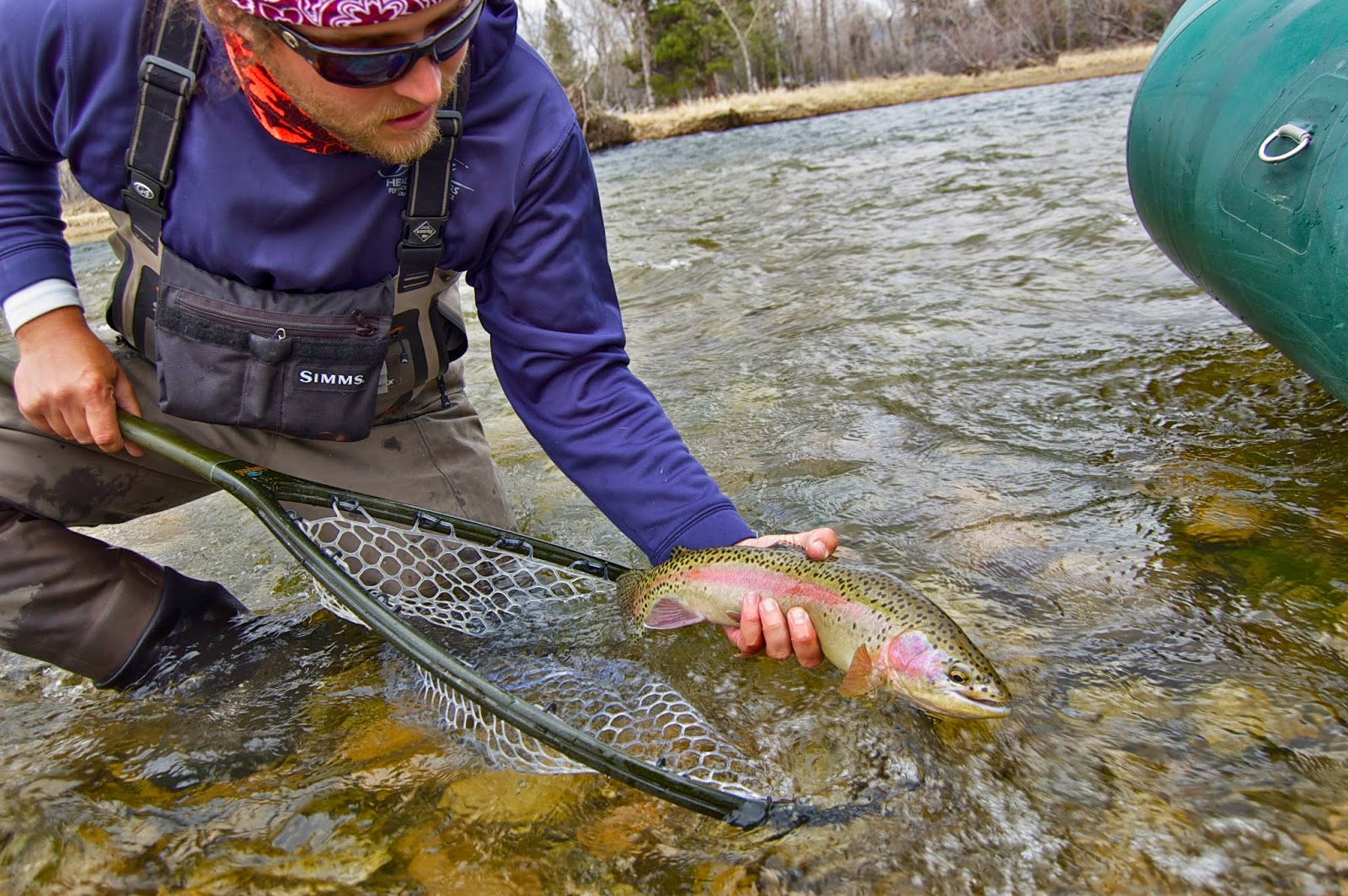
Easy days floating in Western Montana right now. River is coming up with warming daytime temperatures but not too fast to make the fish finicky. Hatches are changing and intensifying by the day. What will tomorrow bring? Skwalas? Moms' Day Caddis? March Browns? All of these bugs plus a few surprising ones are making appearances as weather and flow levels fluctuate. Bring all the flies you have and get out there.

For all us professional fishaholics these are some of the last days of "fun fishing" with good friends before the insanity of guiding season strikes. Our old friend / guide Mark Downey came out fishing with us this past week, bringing a touch of class to the river which he is quick to mention only comes from "time in the barrel". Not sure if this means he has spent time actually inside a charred bourbon barrel or just consumed much of ones' contents (or just an old fisherman speaking in metaphors only he understands). Lazy days floating the river, enjoying a tall can and lying, exaggerating reminiscing about past fishing trips all sounds like the perfect recipe to me. Strange as it may sound pulling oars for two months straight will kill off that top ten percent of giddy-up for floating. Maybe a lazy afternoon sitting in air-conditioning watching ESPN will sound better at that time. Until that hot August afternoon eventually arrives we will be out there scouring the river for all the carnivorous Browns and feisty Cutthroats you can fit in an oak barrel. I heard that from Mark and he might know a thing or two.


Friday, May 1, 2015

Mothers Day Caddis Grab : Pre Runoff Special


Something I needed to remember, something important, something annual, something with flowers. That kind of lingering feeling plus the warm weather of May afternoons can only mean one thing: Its almost Mothers Day. This means a special BBQ with family is fast approaching and the high water of runoff looming close behind it. But before the Bitterroot turns to mud and Rock Creek gets scary-big there is a special bonus hatch to tide us over til June Salmonflies: The little buzzing balls of energy that are Mothers Day Caddis. These hotrods of the insects world will make their seasonal appearance skittering across the river and drive the trout crazy.

Not much technical to fishing this hatch. Bushy caddis patterns in gray/dark green #12-#14, 3x tippet to handle the smashing takes, and a little late spring drive to get a few more fish to the net. Hatch times will be afternoonish and takes will be aggressive, like the fish know they are chasing their last meal for awhile. Heading out of town for a Missouri tailwater weekend is no option for them, they will want all the instant protein they can get. Another nice aspect of this hatch is you can be a little sloppy with the mending: Caddis are so active on the water that a little drag on your fly won't put the fish off their feed.


Sweet Adipose Fin

This is also when we see the last few March Browns of the season stagger to the finish line. While these happy helpless mayflies have been around for a few weeks the fish will continue eating them well into May. March Browns are everything that fishermen love about fishing dryflies and mayfly hatches in particular. They have a concentrated hatch time ( 130pm - 3pm most days ) during which the fish unanimously know that "it is time to eat dry flies now". A whole run full of fish feeding greedily on those tasty sailboats is the best sight in the world. They are the perfect size (#14 usually) that toes the line between easily seen and ultra ninja-sneaky, so you can see the damm thing while also not throwing a giant in-your-face stonefly to back-eddy sippers. Appropriate fly for situation is dry fly angling 101.


All this leads me to thinking the perfect gift for the upcoming holiday would be a dozen or so caddis and mayflies stuck into the Mothers Day bouquet! Then again probably not. I might have to mothball that idea until Fathers Day. . . .

Wednesday, April 15, 2015

Full-swing Into Dry Fly Season : Skwalas On The Move


 Spring dry fly season is off and running here in western Montana, and a mild March and April have bought about one of the best Skwala stonefly hatches of recent memory. Stormy mornings and warmer afternoons have created perfect conditions for these stoneflies to hatch on the rocks and trees along western Montana rivers. As the first major stonefly hatch of the year, the Skwalas get the trout moving like few other hatches. From riffles to tail-outs, well placed drifts are being eaten with conviction as the trout begin to realize that easy meals are readily available after the long winter.

When it comes to spring pre-runoff fishing on the freestone rivers of western Montana, early isn't always better. Ideal dry fly conditions begin shortly before noon as the water warms and the trout start to focus on the first of the morning's bugs. The shoulder seasons of Spring and Fall are when trout apply the bankers hours for eating the dry. They feed hard from about 12-5, and most days that is all they will give you. Put yourself on the best water and move slow during this time to keep yourself into fish.


Trout this time of year are not everywhere. Hard banks, which feature fast churning water, rarely produce strikes on top during the early season; this is especially true with this years higher than normal spring flows. Trout want to eat as much as possible while expending the minimum amount of energy. They move into inside bends, eddies, and tail-outs, where food is plentiful and the water is slow, to feed during the colder water months of spring. By focusing on the slower lazy water you will keep yourself into fish until you are ready to hit home or the nearest brewery.


What makes a good Skwala pattern?
Small and sparse is key. Dry flies this time of year need to be as sparse as possible while still floating through the choppy water. Foam is not a necessity right now, as good stiff elk hair and quality CDC can get you though the rough water while keeping a natural look to your bug. The Skwala patterns that I tend to fish most are in sizes #10 and 12, but I will go to a full #8 if conditions are right. I usually lean towards fishing a bug that is one size smaller than the naturals that are on the water. This is especially important on those colder days or early mornings when the water temps have the fish thinking twice about rising. Often the smaller sneaky bug will draw a fish that would be unwilling to eat a larger fly.


Let the weather man fall on deaf ears:
The threat of bad weather can often keep many anglers at home and off the river. Those who are willing to endure the bad days are often rewarded with moments of dry fly glory all to themselves. A quick warm up after a morning of rain/snow can bring about some of the best dry fly fishing you see all year. Gor-Tex shells, quality waders, wool gloves, and a positive attitude, can keep you into fish even in the worst of conditions. Layer up and get after it. After all, what's a little snow.


Monday, April 6, 2015

Anglers Tonic on Pacific Salmon Populations


Here is a cool article from Greg Thomas over at Anglers Tonic regarding the growing controversy in Salmon management in the Pacific. Always a great ear to the ground regarding environmental impacts of industry and development Thomas' devotes special attention to Salmon and Steelhead news in the northwest. This article focuses on a study regarding increasing competition between populations of hatchery raised fish and native Salmon species. While long considered to be a unlimited resource for fish production it now seems that not all species thrive when total fish numbers increase. The article can be found here:


Anglers Tonic Pacific Salmon stocks


Sunday, March 29, 2015

Clark Fork Early, Clark Fork Often


Fly fishermen have their unique habits, the behavior patterns that make us similar to all other beats of the wild. Year after year it seems I find myself in the same strange rut as years gone by: Driving by the trusty ol' Clark Fork on my way some other far distant trout mecca, leaving the local river all by its lonesome. Why is this? After all the Clark Fork produces dense hatches of caddis and mayflies, supports herds of formidable wily Browns, and despite its proximity to Missoula gets a fraction of the fishing pressure of other area rivers (you Rock Creek / Blackfoot fishermen will know what I'm talking about here). This year I vowed would be a different story and I would make a half-hitched effort to explore the 80 or so miles of meandering trout haunts that lie between Missoula and Warm Springs.

Wading a river is always the best way to get a true understanding of it. You get a good long look at all the structure, rather than just blazing by in a raft, and if you still are not sure whats really down there you just go wade across it. The sheer popularity of float fishing is understandable but its easy to overlook how thorough the wade fisherman is by comparison: Changing tactics and patterns within the same run or eddy can be the difference between striking out and hitting paydirt. Thats not to say that the floating isn't a great way to get after a river too. After a couple a wade trips to learn the types of holding structure the raft gets set lose and the full-day run- n -gun trip is on. Ten miles at a shot of meandering undercut banks and choppy mid river riffle seams. Not a bad plan for a day out on the water, plus when you get a chance to look up from the river, the scenery isn't half bad.


Wednesday, March 18, 2015

Skwalas and Spring Meltdown


Spring is finally, fully underway these days and not a moment too soon: For those of us working through the dark winter months the cabinfever can get to be an ever-present chiming in the background, an itch for the outdoors and moving water that is a tough one to scratch. The spring equinox often signals the end of this dark stretch of the fishermans' calendar and the beginning of some of the best trout fishing of the year: Trout and angler alike seem emerge from hibernation with renewed passion for all things flyfishing. No better way to kick off the season on the Bitterroot then with a little dry fly action in the overcast!

With the warming temperatures comes the first major topwater action of the year with the hallowed Skwala stonefly. Though only a harbinger of the monster stonefly hatches of summer Skawals are a delicious early season morsel for the trout hungry from a long winter of slim pickings. Despite the throngs of eager rods patrolling the shoreline the it can be a notoriously hit-or-miss hatch for the angler. Quite a few of the rather helpless insects need to be on the water to get the trout's attention, but when they do the feed is fully on: A big Cutthroat can't help but slurp such a easy meal no matter where it happens to find it. Of course no Skwala fishing trip would be complete without that glorious spring weather. Tshirts and balmy sunshine one moment and spitting all kinds of sleety nasty snow pellets the next. Its always a good idea to plan on wearing the Gortex. All of it.


Best Spots Ever


Friday, February 20, 2015

Fly Tying: Woolly Bugger Alchemy


Our last post took a look at some foundational tricks in building flies, insights on technical aspects of tying that lead to less time spent behind the vise as well as better bugs. But what about refining patterns and building that collection of one-of-a-kind "secret flies", those flies that just drip with fishiness and get tied on it all the pressure situations? Over the years building as many bugs as I have (both commercial and personal) there are certain patterns that stick out as being perfect examples of this "dripping with fishiness", those bugs that seem to hop around on the bench and are begging to get thrown to a big gulper.


Go Natural:
Relying heavily on the long-time favorite staple materials is the best thing you can do for your fly box: Talking about Elk, Deer, Calf tail, Pheasant tail, CDC, and natural dubbing fibers. This emphasis helps enormously when it comes to building patterns that work all over the place, not just on your home waters; And work equally well on the selective and the uber-agressive fish. Mid-summer western MT on the Bitterroot, Blackfoot, Clark Fork, and Rock Creek, you can get away with throwing the most heinous birdnest of foam and spandex imaginable and it will get bit. Now compare that killer Bitterroot bug with a favorite from central MT like the Madison, Beaverhead, or Missouri. I guarantee you will see a fly built with CDC, elk, deer, calf, or just a pile of hackle. The synthetic materials are either supporting players at best or entirely non-existent. This might be read as a tacit argument for the superiority of Salmo trutta as an evasive fluvial predator (probably mos def) but that is a rant for another time. The flies that are considered sure bets on famous technical streams are mostly tied with natural fibers. The big fish and the spooky fish think they look better. Hmmmmm

This natural material bias also becomes the gold standard when tying the high-pressure patterns that get chucked at the biggest fish. My back-pocket top-secret big fish box contains no (NO!) foam flies whatsoever. To the untrained eye it is a detritus pile of ants/hoppers/cripples/tricos/emergers mixed with river mug and baked in the sun. If you tweeze out one of these flies, however, you will find a little bundle of hair and hackle that doesn't stand out or look out of place swirling around a scumline, or more likely hanging from a branch. "Damm that wind came up at the wrong time, didn't it!" These are the flies you learn to love and with time will come to rely on completely.


Gone (Rejected), But Not Forgotten:
Scrutinize the living S#%* out of every fly lying around your vehicle or fishing gear that has gotten the ever-loving piss chewed out of it: That one parachute that got crushed the first day of the hatch, 20+ fish on one bug that everytime it miraculously continued floating. . .  Slurp! That one bugger the fish would not leave alone in that one side channel below Craig. Why the hell were the fish all over that fly? Why weren't they smacking the other flies in the box? Checking the throw-aways is the fastest way to get at answering this question. Build the traits of these killer bugs into the rest of your arsenal and see what happens.  

Another good way to think about how flies could look is to look at those that get rejected from the bench: The ones that never see the fly box and get given away or straight chucked in the trash. Small tweeks to silhouette and body proportion are in every bug that doesn't quite measure up to what you "think" the right fly looks like.  One of my favorite late-season mayfly patterns came about from one of these so-called rejects. I was short on flies for a guide trip the following day and scoured the bench for anything I thought might have a chance at catching a tree, a rock, or a fish. One of these scavenged flies had the biggest, fattest, chunkiest thorax I could have imagined on a mayfly, so fat that I had my doubts as to whether with all the gink and powder floatant at my disposal it would even float at all. It went in the box and got tied on at the first sign of the afternoon Mahogany hatch the next day, the only real top water activity that time of year. First it got slurped. Then it got chugged. Ten or so fish later it got cut off without much fanfare as I had a small reserve of the same fly that in my mind were "properly tied" and would work just as well. These pretty flies floated better and looked to my eye the same on the water but they got bit hardly at all. Like really infrequently. So much so that after 30 minutes and a few paltry bites the Chunky Monkey Mayfly got resuscitated and throw back out to be chewed into oblivion. One reject fly siring a whole clan of thick-thighed trout-hunting descendants! Natural Fly Selection at its finest . .. . 

                             
Contains .005% synthetic fibers.

One of a Kind : Rich & Rare:
Blend your own dubbing! Simple as that.  Catch bugs and look at em' reeeeaaaaallll close. Buy one package of every color from Hareline and go wild. Mix and match and develop favorites. I have no doubt that right out-of-the-bag most dubbing colors will work fine, but I also know as a empirical fact that blended dubbings work better. Why? First off they are one-of-a-kind blends matched specifically to the local bugs you are imitating. Guides and entomologists are impressed regularly by the subtle color variation within a species, often separated only by a single drainage. The bugs are taxonomically the same but are eating different forage, hiding in different tone of water, and as a result pop out in slightly different shades. Sometimes subtlety and not RAW DETERMINATION is the name of the game. If this is the case you best come correct.

Secondly, if you blend your own dubbing you know that each drift is the first time the fish has seen THAT color / shade / combination / hue. I know, superstitious, vague, unquantifiable, voodoo jargon, "guide talk". . . . Well lemme just say that believing in intangibles like confidence and x-factors makes you a more formidable fisherman than not believing in them. And having the only homespun goldenstone floating amongst a flotilla of store-bought spandex is a pretty big intangible. If that homespun bug is also mostly natural materials and has a slightly "hefty" build to it, then i think the intangibles are all aligned in your favor and the fish must bow before you. I will take that kind of fly to the races any day.